
For the last two weeks of August, Lama Jampa Thaye gave the annual summer course of teachings at Sakya Changlochen Ling. Around 100 people travelled from the US, Mexico, the UK and Europe, including those making the journey for the first time.
The course was the culmination of months of planning, with three preparation visits to clean, fix, paint,weed and plant, and to assemble the brand new marquee. As this was the first course since the passing of the Centre’s co-ordinator, David Armstrong, particular care was taken with the planning, building on his many years of painstaking work. In all, over 30 people gave their time to make the course a success, under the direction of the dedicated management team.
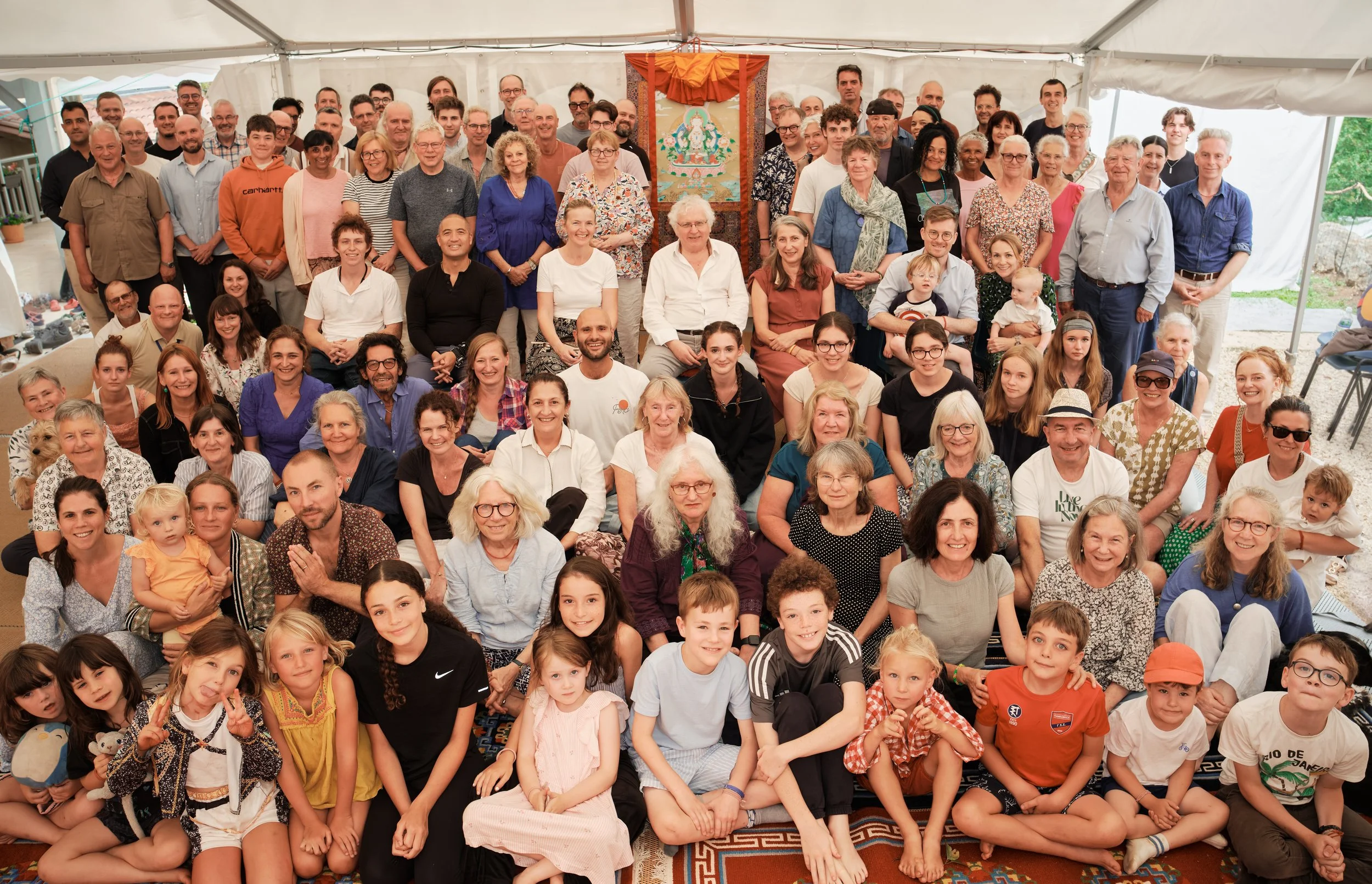
In this setting, with its wild, parched beauty (but fortunately no wildfires), Lama Jampa and Dechen Dolma arrived to a traditional greeting by course attendees, offering white scarfs (kataks). The course opened with the initiation of White Dzambhala, from the lineage of Atisha. A manifestation of Chenrezik, the Buddha of compassion, the practice of White Dzambhala removes the suffering of poverty and sickness, purifies non-virtuous karma and cultivates bodhichitta.
For the rest of the first week, Lama Jampa taught Chapter 8 of Shantideva’s rich and poetic text on the path of the bodhisattva, ‘Entering the Bodhisattva Conduct’ (Skt. Bodhicaryāvatāra), from the commentary by the great Sakya master, Sonam Tsemo. In these verses, Shantideva explains how to disentangle ourselves from our usual, worldly concerns and self-interest and instead create the space to practise, so that we can settle the mind on bodhichitta, the wish to become a Buddha for all beings. As Shantideva points out, there is nothing special about our wish to have happiness, as,
...different beings, whether happy or suffering,
All want to be happy, just as I do.
The second week comprised group meditation on White Tara of the Wish-fulfilling Wheel from the Tsarpa lineage of Sakya, with course attendees receiving the initiation and detailed instructions (‘Bestowing the Coolness of Longevity, the Oral Instructions of the Blissful Lord’) by Ngawang Lekdrup before engaging in the practice. Meditation on White Tara is one of the principal vajrayana means of achieving a long life, so that we have more time to engage in Buddhist practice, as demonstrated in the life of the 11th century master, Vagishvakirti, who received the practice within a treatise given to him by Tara herself.
Over the two weeks, Lama Jampa also took time to respond to questions not only on the course content, but also on how to bring practice into daily life, whether that’s at work or when spending time with family, with much practical advice shared.
Lama Jampa concluded his summer teachings in France with a short visit to Karma Euzer Ling in Normandy. Here he taught five of Karma Chakme’s eight songs on the Union of Dzogchen and Mahamudra. The teachings were well attended and deeply appreciated by all.